
Noiser
How the Viking Age in England began
Play Real Vikings 1. Murder on Chesil Beach
 In 793 AD, Viking ships cut through the North Sea and made landfall at the Holy Island of Lindisfarne. Monks were slaughtered, treasure looted, and a sacred place was left smouldering.
Stories of these bearded strongmen from across the sea spread far and wide. Chroniclers bewailed the arrival of these ferocious strangers from beyond the horizon, harbingers of death.
In the following years, Viking raiding escalated. They travelled England’s coastlines and rivers, striking monasteries and towns with unnerving speed.
While the Lindisfarne raid is often seen as their first foray in England, this is actually not the case…
The Killing at the Coast
Four years earlier, in 789 AD, another altercation took place, this time on England’s south coast.
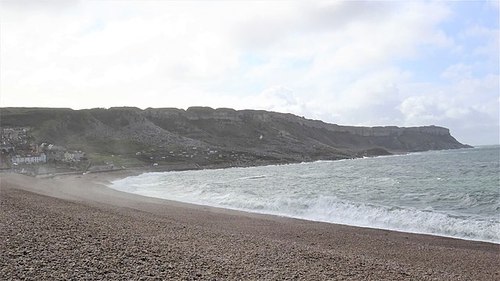
At Chesil Beach, a Saxon official named Beaduheard rode down to meet a group of foreign traders who had landed without permission. His duty was simple: to re-direct the men to a king’s port, so that they could pay the correct taxes. And that’s exactly what he intended to do.
Except, he’d never dealt with men quite like this…
The strangers wore helmets of either leather or metal. Axes, daggers and swords hung from their baldrics. Their muscled arms were ringed with gold, and one or two wore small gilded hammers around their necks, the symbol of a pagan god... Thor, the bringer of thunder. Their hair and beards appeared well-groomed, and dark-green tattoos were visible on their exposed skin.
When Beaduheard confronted them, they turned on him and his party - ruthlessly cutting him down. As they pushed their longboats back out into the waves, the shingle was stained with blood.
It seems that the first blood spilled by a Viking in England was not on Lindisfarne after all, but here, on a quiet stretch of southern coastline.
New Beginnings?
Traditionally, the late 700s were viewed as the beginning of the Viking age. But an archaeological discovery in 2008 changed experts’ thinking - pushing the start of the Viking period back at least 50 years.
Construction workers in the village of Salme, on the island of Saaremaa in Estonia, uncovered human remains. Work halted, and archaeologist Marge Konsa from the University of Tartu was called in to investigate.
After finding more bones, as well as ancient spearheads and gaming pieces, Konsa and her team unearthed the most extraordinary discovery yet: the remains of a 38-foot-long ship. Perhaps even more incredible, inside the ship were the skeletons of seven men, some bearing lethal wounds. These, it seems, were warriors who died in battle. This was followed by an even bigger ship: 55-feet-long with fragments of a sail still attached to its mast, with thirty-three dead inside. Isotope analysis of the men’s teeth revealed that many of them came from the Mälar Valley in Sweden.
Radiocarbon dating placed the burial between 700 and 750 AD.
So now we're back to the middle of the eighth century. With that, we get this debate: when does the Viking Age begin?
Davide Zori, Associate Professor of History and Archaeology at Baylor University