
Noiser
How the Vikings did battle
Play Real Vikings 3. Blood Eagles: The Great Heathen Army
 When you think of Vikings in battle, you might picture longships cutting through the mist, bearded warriors leaping ashore with axes aloft, howling like wolves as they swing and bludgeon their way through terrified enemies.
There’s a lot of truth to this. But in addition to being fearsome hell-raisers, the Vikings were actually more savvy than their reputation might suggest.
Most of the time, they aimed to avoid pitched battles against well-armed soldiers if they could. Instead, they preferred soft targets, like unarmed monks and villagers who would not put up much of a fight. Their goal was less to achieve glory or symbolic victories.
It was plunder.
Monasteries, trading towns, and coastal settlements were the perfect targets: wealthy, lightly protected, and often completely unprepared for an attack from the sea.
Speed and surprise were their greatest weapons.
Vikings were not great out in the open. In fact, there are several examples of when they're caught in the open, it doesn't end well for them. They're hit-and-run people. Their speed makes them absolutely terrifying.
Lars Brownworth, author of The Sea Wolves: A History of the Vikings
In the Blood
For many Scandinavians of the Viking Age, warfare was simply a way of life.
From the time they were old enough to hold a wooden sword, boys were raised in a culture that valued strength, courage and skill in combat.
And fighting was not exclusively the domain of men.
A unique feature of Viking warfare was the advent of the “shieldmaiden”, female fighters as adept and every bit as fierce as their male warrior counterparts.
Weapons of War
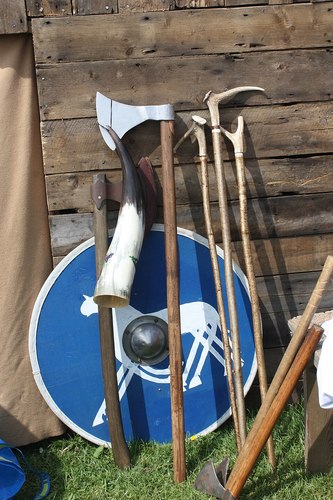
Weaponry was clearly vital to the Vikings.
The most important defensive tool was the shield. Usually circular, made of wood and reinforced with metal at the centre, these could be overlapped to form an impenetrable bulwark, a mighty battering ram - the famous “shield wall”.
Behind this wall, Viking warriors wielded a range of offensive weapons.
When an engagement descended into a free-for-all, spears and stabbing knives were common. They were relatively cheap to make, effective and versatile. Swords were also used, and were often tailored to the owner to convey status and wealth.
But the weapon perhaps most associated with Vikings is the axe.
These were not tools snatched from a woodshed on the way to the longboat. Viking battle-axes were carefully designed instruments capable of splitting shields or armour with devastating force. Many were light enough to be used with one hand, allowing the warrior to fight with shield and axe simultaneously.
For protective clothing, a Viking warrior would wear padded leathers, some with the addition of chainmail or a breastplate.
Helmets were also used, typically iron-made with a simple, rounded shape and a nose guard.
However, it is time to dispel one of the most enduring and erroneous myths - that Vikings wore horned or winged helmets.
Despite their place in the popular imagination, and as striking as the imagery is, such helmets would have been wildly impractical, not to mention dangerous for the wearer.
Having huge handlebars on your helmet is not a good idea going into battle.
Lars Brownworth, author of The Sea Wolves: A History of the Vikings
Berserkers
While the Vikings were made from flesh and blood, and just as susceptible to falling to a sword in battle as anyone else, part of what separated them from their foes was the huge psychological advantage they wielded.
Some Norsemen belonged to a legendary cult known as “berserkers”.
These men would ingest alcohol and hallucinogenic substances before a battle, working themselves into an animalistic frenzy. Launched into the fray as demonic shock-troops, they would sometimes abandon weapons and armour altogether - fighting, literally, tooth and nail.
The effect on the battlefield could be profound. A wild-eyed berserker charging forward in a screaming frenzy could shatter enemy morale before the fight had even begun.
You could lop off an arm, and they would keep coming. They were absolutely terrifying - and also terrifying to their fellow Vikings.
Lars Brownworth, author of The Sea Wolves: A History of the Vikings
The Terror of the Longship
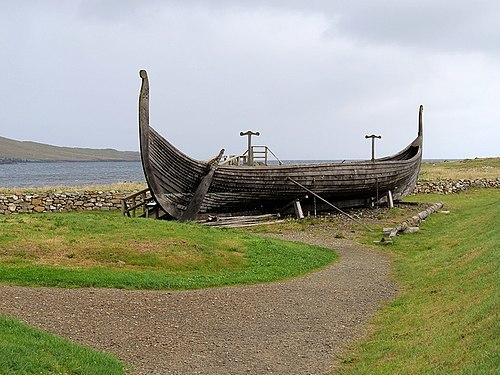
The Vikings’ greatest advantage, perhaps, lay in their ships.
The Viking longship was an incredible feat of engineering - fast, flexible and capable of sailing both the open ocean and shallow rivers. This allowed Viking forces to travel enormous distances and strike far inland, providing them with a range of potential targets: remote island monasteries, riverside market towns, coastal villages.
For the people of early medieval Europe, the sight of a dragon-prowed longship on the horizon would have been utterly terrifying.
And by the time defenders gathered to resist them, the raiders were often already gone, sails disappearing over the horizon, plunder safely stowed, en route to their next unsuspecting target.